

The most advanced brucellosis diagnostics in the world!
Brucella FPA
The Brucella FPA is the test of choice for the largest successful brucellosis eradication campaigns in the world.
General
Information
The Brucella FPA encompasses a suite of diagnostic test kits that detect antibodies against smooth Brucella species in animals and humans.
The kits are based on fluorescence polarization technology and use an O-chain polysaccharide (OPS) antigen extracted from B. abortus and B. melitensis that is conjugated with fluorescein.
The presence of antibodies specific for the OPS antigen is indicative of a current or recent Brucella infection. The assay run time is only a few minutes, and the test can be run in the field or a lab.
OPS test
Assay time 5 min
Multi species test
Test of choice for vaccinated animals
Comparison
to other technologies
The Brucella FPA measures an antibody response against the OPS part of the lipopolysaccharide (LPS) molecule. In contrast, RBT, ELISA, and most cELISA kits detect long-lasting antibody responses to the entire LPS including Lipid A and the core oligosaccharide. In addition, FPA does not amplify the signal; therefore, it is a semi-quantitative system for measuring Brucella activity in an animal.
This greatly enhances our ability to distinguish between animals that were infected with field strains or vaccines and those that were able to clear an infection.
READY TO FIGHT BRUCELLOSIS? MAKE THAT CALL!
Performance in
different situations
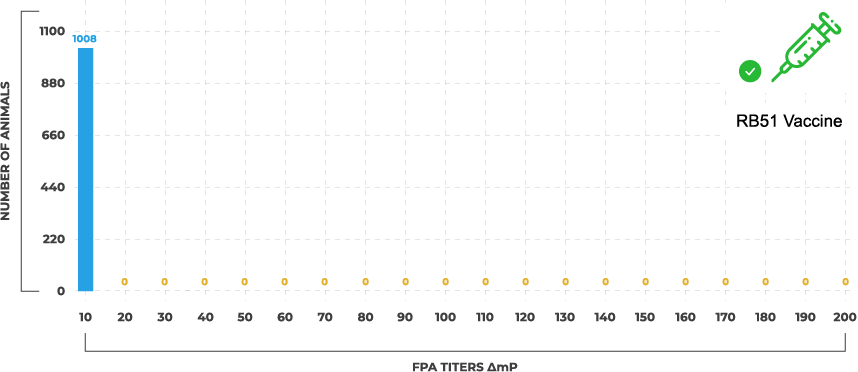
The following are frequency distribution graphs of FPA results from different farms. The X axis represents the test results, and the Y axis represents the number of animals that showed a certain result.

Graph 1 shows that in a negative population, vaccinated with RB51 vaccine, no signals are detected. The results are very clear and unambiguous.
Millions of tests have been performed on animals in similar setup and the Brucella FPA consistently displays maximum specificity.
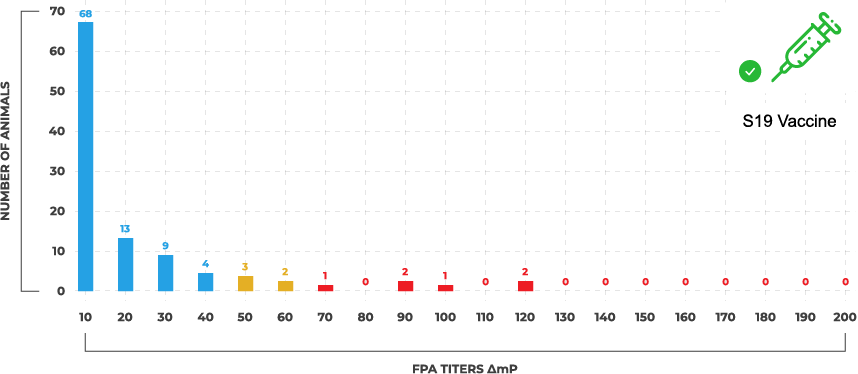
Graph 2 shows results from a farm that was successfully vaccinated with the Strain 19 vaccine. Some animals show a medium-positive signal, but there are no high-positive animals. Medium-positive animals are having difficulty clearing the infection and should be considered a risk to the population and managed separately or removed/milked out. Frequent testing of the herd will eventually lead to full clearance of the vaccine infection and successful immunization.
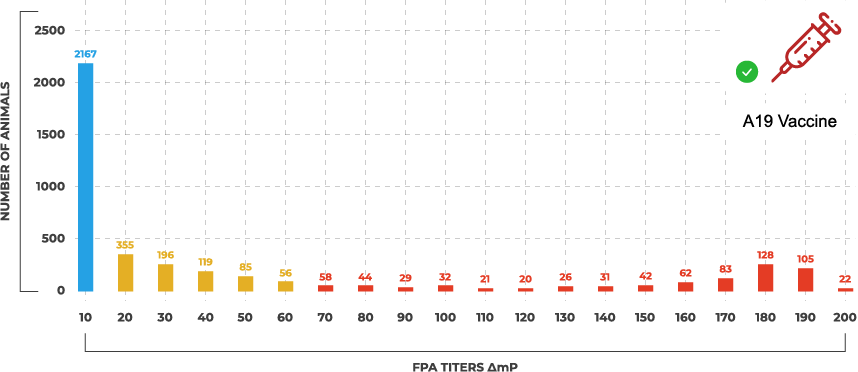
Graph 3 shows the results of an A19 vaccination administered on a negative population. This has caused many animals to be infected with the brucellosis vaccine. In this case, too many vaccinations were administered, especially to the adult population. If vaccination is not followed by testing, there is a high risk of developing a slow-moving, vaccine-induced brucellosis outbreak. A hallmark of this situation is an outbreak of brucellosis among farm workers.
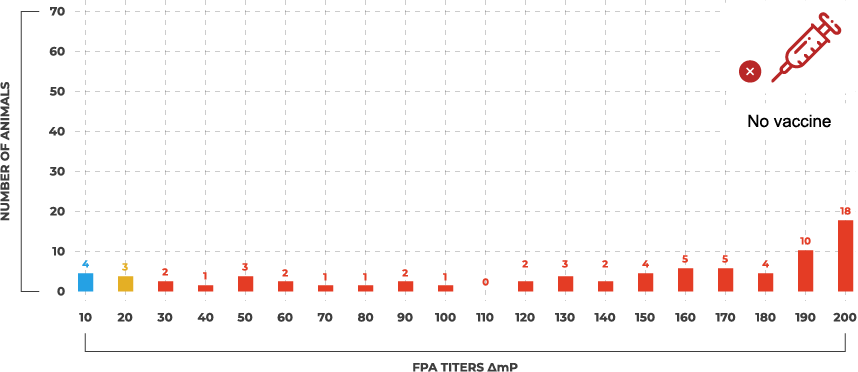
Graph 4 shows results from a non-vaccinated, positive farm. Typically, a lot of animals show high-positive results: all samples above a titer of 20 ΔmP are true positives.
PERFORMANCE
There are numerous reports that discuss the specificity and sensitivity of the Brucella FPA. Tables shown here display results of our own studies on defined sets of positive samples and well-defined negative samples from a negative population. The specificity of the Brucella FPA is over 99%. The most recent USDA’s report on the specificity of the testing system, reported at the Annual Meeting of the United States Animal Health Association in 2017, places specificity at 99.994%. This system consists of an automated RBT screening and FPA confirmation testing. Contact us for more information.
|
Bovine serum samples (B1001) True status | |||
|---|---|---|---|
| Positive | Negative | ||
| Test results | Positive | 205 | 1 |
| Negative | 2 | 1009 | |
| Sensitivity 99% | Specificity 99.9% | ||
|
Sheep serum samples (B1002)
True status | |||
|---|---|---|---|
| Positive | Negative | ||
| Test results | Positive | 86 | 0 |
| Negative | 0 | 597 | |
|
Sensitivity 100% |
Specificity 100% | ||
|
Bovine serum samples (B1002)
True status | |||
|---|---|---|---|
| Positive | Negative | ||
| Test results | Positive | 105 | 0 |
| Negative | 0 | 92 | |
|
Sensitivity 100% |
Specificity 100% | ||
Ordering
information
This is the original version of the Diachemix Brucella FPA with instructions that cover the use of the product in various species and for three types of samples. Recommended for testing cattle. Milk testing requires the use of ClearMilk™ Buffer, product code C1001.
| Trade name | Brucella FPA |
|---|---|
| Technology | Flourescence Polarization Assay (FPA) |
| Antigen | Brucella abortus OPS |
| Analyte | Ig all classes |
| Species | Bovine, bison, buffalo, cervids |
| Samples | Serum, plasma and individual milk samples |
| Ordering information | B1001- 250 (250 tests kit) B1001- 1000 (1000 tests kit) |
This product is a new version of the original Brucella FPA test kit. Three components of the test kit (Positive Control, Negative Control, and the Tracer) have remained unchanged from the original Diachemix® Brucella FPA, product code B1001. The new formulation of the Sample Diluent provides more consistent data on the negative population of animals because it is better at handling sample background and interference. This kit contains a mix of both A and M tracers. It tests for the presence of B. melitensis and B. abortus antibodies in serum and milk from various species. Milk testing requires the use of ClearMilk™ Buffer, product code C1001.
| Trade name | Brucella FPA II |
|---|---|
| Technology | Flourescence Polarization Assay (FPA) |
| Antigen | Brucella abortus (A) and Brucella melitensis (M) OPS |
| Analyte | Ig all classes |
| Species | All animals including marine mammal |
| Samples | Individual serum and milk samples |
| Ordering information | B1002- 250 (250 tests kit) B1002- 1000 (1000 tests kit) |
This product is a qualitative test that uses Fluorescence Polarization technology to detect the presence of antibodies specific for smooth colony-producing Brucella species (B. melitensis, B. abortus, and B. suis – Rev. sci. tech., OIE 1982) in patient serum. The presence of antibodies is indicative of a prior Brucella infection.
| Trade name | Brucella FPA Medical |
|---|---|
| Technology | Flourescence Polarization Assay (FPA) |
| Antigen | Brucella abortus (A) and Brucella melitensis (M) OPS |
| Analyte | Ig all classes |
| Species | Human |
| Samples | Individual serum samples |
| Ordering information | B1003-250 (250 tests kit) |
This product is a qualitative test that uses Fluorescence Polarization technology to detect the presence of antibodies specific for smooth colony-producing Brucella species (B. melitensis, B. abortus, and B. suis – Rev. sci. tech., OIE 1982) in individual or bulk milk samples. It can be performed in the field, and it is used on smaller farms to quickly assess the problem. The presence of antibodies is indicative of a current or recent Brucella infection.
| Trade name | Brucella FPA Milk |
|---|---|
| Technology | Flourescence Polarization Assay (FPA) |
| Antigen | Brucella abortus (A) and Brucella melitensis (M) OPS |
| Analyte | Ig all classes |
| Species | Bovine |
| Samples | Individual and bulk milk samples |
| Ordering information | B1004- 250 (250 tests kit) |